
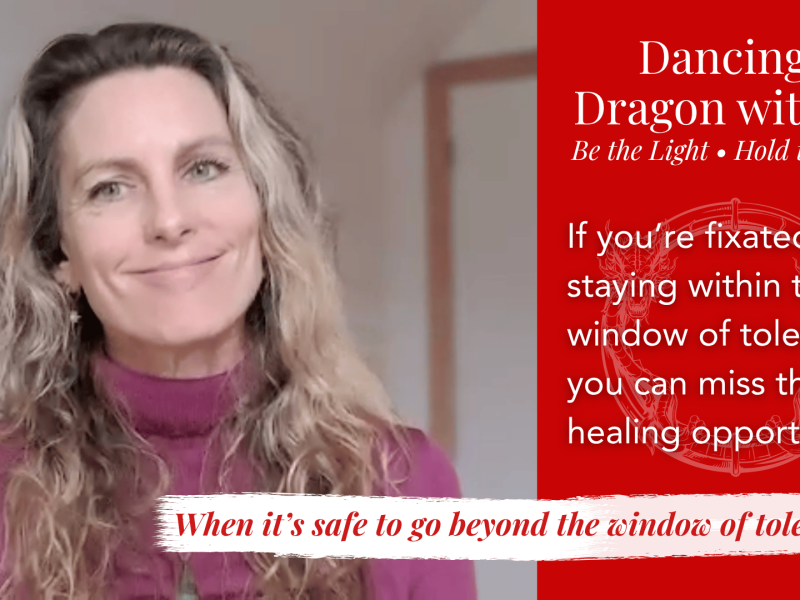
In much of contemporary trauma work, practitioners talk about the window of tolerance — a concept developed by Dr. Dan Siegel, psychiatrist and founder of the Mindsight Institute.
It describes the range of arousal within which a person can function smoothly: think clearly, feel emotion, and stay connected to themselves and others. When the nervous system moves outside that window, it swings toward hyperarousal (anxiety, panic, fight/flight) or hypoarousal (numbness, collapse, freeze).
Many trauma-informed modalities — from Somatic Experiencing (Peter Levine) to Sensorimotor Psychotherapy (Pat Ogden) — aim to keep clients within or gently expand this window. The goal is regulation, safety, and integration.
But what happens when healing asks us to go beyond that window?
Choosing to Go Beyond
In my work with clients, we deliberately enter the territories that lie outside the ordinary window of tolerance. These are the places the psyche and body once avoided — the samskāras, or undigested imprints of experience.
We don’t do this recklessly. The client never goes there alone. My role is to hold the field — to stay grounded, regulated, and attuned so the client can move through intensity while still feeling safe.
This approach aligns with the Polyvagal Theory developed by Dr. Stephen Porges, which maps how the autonomic nervous system constantly scans for cues of safety or danger (a process he calls neuroception).
Even when a client’s system moves into sympathetic activation or dorsal shutdown, my regulated state continues to signal safety through connection. That signal, transmitted through voice, breath, eye contact, and presence, activates the client’s ventral vagal system, allowing them to experience intense activation without losing relationship.
What Happens Neurologically
When we re-enter an unresolved emotional experience, the subcortical brain structures that originally encoded the trauma — the amygdala, hippocampus, and periaqueductal gray — light up. The nervous system runs the old survival program: fight, flight, freeze, or collapse.
In ordinary circumstances, this activation would lead to avoidance or dissociation. In the held space of co-regulation, however, something extraordinary becomes possible: the client can stay present to the activation. Their prefrontal cortex and insula — regions responsible for self-awareness and interoception — remain online, creating dual awareness: the body relives danger, yet consciousness knows safety.
This paradox rewires the brain. The implicit memory of threat updates through memory reconsolidation, a process described in both neuroscience and trauma therapy research. The nervous system learns a new truth:
“I can feel this and survive.”
Discharge and Completion
As the body revisits what was once too much, the interrupted survival response completes. Tremors, shaking, heat, tears, breath surges, or spontaneous movement often appear — the body’s way of releasing the trapped activation that was frozen in time.
Peter Levine calls this completing the defensive response. Biologically, the midbrain motor circuits finish what they couldn’t complete during the original event. The HPA axis down-regulates, stress hormones normalize, and energy that was bound in defensive tension returns to flow.
The discharge is not catharsis for its own sake — it is the nervous system reorganizing itself. Once this process resolves, the person often experiences deep calm, clarity, or peace: the hallmark of parasympathetic restoration and integration.
Alchemy: The Dissolution of Samskāra
In Tantrik terms, what was once trapped as a samskāra — an unassimilated energetic residue of experience — now dissolves back into consciousness.
The emotions that were never fully felt are now alchemized – often clients will move through a range of emotions until they finally hit ‘lightness’, or ‘calm’.
At a neurobiological level, this is re-patterning; at a spiritual level, it’s alchemy. The energy once locked in separation rejoins the totality of being.
Beyond Regulation, Toward Liberation
This approach doesn’t reject the window of tolerance; it recognizes that there is a broader frame beyond it. The game isn’t about staying within the window, but finding ways to explore all the way through it. First with co-regulation with another (like myself, in session) and then eventually by oneself, as the ability to stay orientated to awareness stabilizes.
Plus, when the nervous system learns that it can move through terror, shame, or grief while staying connected, the window naturally widens. Life force that was frozen begins to move freely.
Eventually, awareness holds every state — hyper, hypo, or regulated — as expressions of one continuum.
In Essence
When I work with clients, I am not helping them avoid dysregulation. I am teaching the body and mind that they can enter the very places that once felt unbearable whilst also staying conscious, connected, and safe.
Through co-regulation, presence, and awareness, the nervous system discharges what was incomplete, the psyche integrates what was split off, and the soul reclaims what was lost.
This is the art and science of going beyond the window of tolerance — the meeting point of neuroscience, embodiment, and awakening.
References & Influences
- Dr. Dan Siegel – The Developing Mind, Mindsight, and the Window of Tolerance
- Dr. Stephen Porges – Polyvagal Theory and the social engagement system
- Dr. Peter Levine – Waking the Tiger, In an Unspoken Voice
- Pat Ogden – Sensorimotor Psychotherapy
- Allan Schore – right-brain-to-right-brain regulation and affective neuroscience
- Trika Shaivism – the Tantrik understanding of samskāra, śakti, and liberation through awareness
Joy Rebel Coaching with Kara-Leah
Kara-Leah has worked with hundreds of clients and students as a mentor & coach. She helps people identify and dissolve their conditioning, reprogram their operating systems (psyches), and step into their desired experience of life. Her focus is on supporting clients to open to the Joy of Awareness, available in every moment, whilst strategically navigating the inevitable challenges of life. She has a laser-sharp ability to identify the old wounds and mindsets keeping people stuck, and ways to support their immediate dissolving.



 The Biggest Mistake I made after Kundalini Awakening